



Peer to Peer (P2P) Lending Market Trends, Leading Companies, Company Revenue / Sales Performance, Subscriber Growth, Pricing Strategies, Cloud Adoption, Infrastructure Expansion, Competitive Landscape, and Industry Outlook
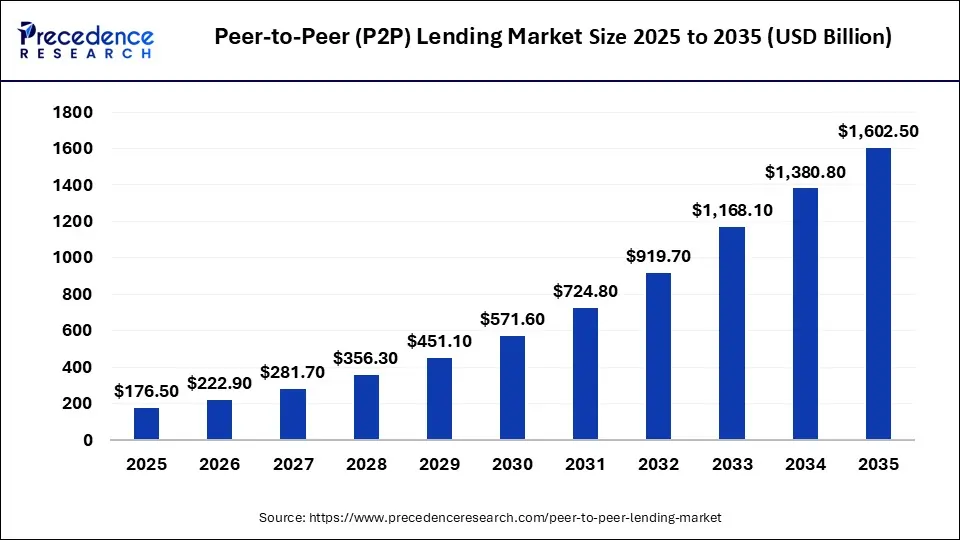
ICT industry specialist Gautam Mahajan estimates the peer to peer (P2P) lending market at USD 222.90 billion in 2026, with continued technology adoption expected to take the market to USD 1,602.50 billion by 2035 at a CAGR of 24.68%. Leading peer to peer (P2P) lending market providers such as funding circle, mintos, upstart, lendingclub, faircent are expanding their capabilities across segments including type, end user, business model.
Source: https://www.precedenceresearch.com/peer-to-peer-lending-market
 Get a Sample
 Table Of Content


What is the Peer to Peer (P2P) Lending Market Size?
The global peer to peer (P2P) lending market size is accounted at USD 176.50 billion in 2025 and predicted to increase from USD 222.90 billion in 2026 to approximately USD 1,602.5 billion by 2035, expanding at a CAGR of 24.68% from 2026 to 2035. The growth of the peer-to-peer (P2P) lending market is attributable to the increasing requirement for education loans and healthcare financing. Owing to the high gross domestic product (GDP), favorable economic policies, and early adoption of the latest financial alternatives, the peer-to-peer (P2P) lending market is predicted to grow remarkably.
Key Takeaways
- North America dominated the global market with the largest market share of 37.40% in 2025.
- Asia Pacific is expected to expand at a solid CAGR of 25.52% during the forecast period.
- By type of loan, the consumer lending segment captured the highest market share in 2025.
- By type of loan, the business lending segment is expected to grow with the highest CAGR between 2026 and 2035.
- By end user, the consumer credit loans segment dominated the market in 2025.
- By end user, the real estate loans segment is expected to grow at the fastest rate during the forecast period.
- By business model, traditional lending held the largest share in 2025.
- By business model, marketplace lending is expected to grow at the highest CAGR between 2026 and 2035.
Impact of Artificial Intelligence (AI) on the Peer to Peer (P2P) Lending Market
P2P lending is typically done through AI platforms that match borrowers with potential lenders. P2P lending offers secured lenders and unsecured lenders. However, most loans in P2P lending are unsecured personal loans. Secured loans are rare in the industry and are usually secured by luxury goods. Technologies like artificial intelligence (AI) and machine learning (ML) help increase the efficiency of P2P lending.
AI is revolutionizing peer-to-peer lending by improving risk assessment and matching borrowers with lenders. Advanced AI systems can even be used to reach and engage customers. With technologies like voice chat AI, peer-to-peer lending companies can manage phone calls and attract customers at a larger and smaller scale. This will lead to the growth of the peer-to-peer (P2P) lending market through the use of AI-driven technologies like WIZ to facilitate customer crystallization and dissemination.
How has AI benefited the market?
Artificial intelligence(AI) has played a transformative role in the Peer to Peer (P2P) lending market by enhancing operational efficiency, improving credit risk assessment, and enabling more personalized borrower lender interactions. AI driven algorithms analyse vast amounts of structured and unstructured data, including alternative credit indicators like transaction history, digital footprint, and behavioural patterns, to generate more accurate credit scores for borrowers who may lack traditional credit histories. This has significantly expanded access to loans for underserved population. Additionally, AI powered Chabot's and automated customer service tools streamline borrower support, reducing overhead costs and improving user experience. Fraud detection systems also benefit from AI's ability to spot anomalies and suspicious activities in real time, helping platforms maintain compliance and minimize risk. Overall, AI has strengthen the reliability and scalability of P2P platforms, making them more attractive to both investors and borrowers in an increasingly digital financial ecosystem.
Growth Factors of the Peer to Peer (P2P) Lending Market
- P2P lending connects lenders and borrowers through a platform that makes access to credit easier. It has the advantages of simple information, fast processes, and a large number of borrowers, which has led to the growth of the peer to peer (P2P) lending market.
- P2P lenders often offer lower interest rates than traditional lenders because they have lower administrative costs and do not have to pay for personnel or staff, which has led to the growth of the peer to peer (P2P) lending market.
- P2P lending platforms are available to people who cannot get a loan from traditional lenders due to credit history or other reasons, which has led to the growth of peer to peer (P2P) lending market.
- P2P lending platforms use technology to facilitate credit checks and loan approvals, they have a faster approval process than traditional lenders, which has led to the growth of the peer to peer (P2P) lending market.
- P2P lending has become popular in recent years because it offers an alternative to traditional lending, which is often slow, expensive, and inaccessible to many, which has led to the growth of the peer to peer (P2P) lending market.
Market Scope
| Report Coverage | Details |
| Market Size in 2026 | USD 222.90 Billion |
| Market Size in 2025 | USD 176.50 Billion |
| Market Size by 2035 | USD 1,602.5 Billion |
| Growth Rate from 2026 to 2035 | 24.68% |
| Leading Region | North America |
| Fastest Growing Region | Asia Pacific |
| Base Year | 2025 |
| Forecast Period | 2026 to 2035 |
| Segments Covered | Type, End User, Business Model, and Geography |
Market Dynamics
Driver
Flexible Investment Options
Depending on their interests and risk tolerance, investors can manually search through the loans that are accessible on the platform and select which ones to invest in. As a result, investors have complete control over their financial choices and can customize their portfolios to meet certain needs or tastes. To spread risk and possibly boost rewards, investors can distribute their money among a number of loans.
Additionally, some platforms provide investors with the opportunity to divide their investment into multiple loans of lesser amounts by offering the option to invest in fractional loan parts. Investors can continually reinvest their profits without human interaction thanks to the automatic reinvestment options offered by many platforms. Thereby, the emergence of flexible investment options act as a driver for the peer to peer (P2P) lending market.
Restraint
Credit Risk Concentration
In peer to peer (P2P) lending market, credit risk concentration is the extent to which a platform's loan portfolio is exposed to a limited number of borrowers or a certain category of borrowers. Should a substantial percentage of loans be originated in a certain geographic area, the platform would be vulnerable to regional legislative changes or economic downturns. The platform may be subject to industry-specific risks if loans are concentrated within a certain industry. For instance, in the event of a downturn in the technology industry, a platform that extends loans primarily to borrowers in that industry may be more vulnerable.
Opportunity
Social Impact Investing
Lending to people or companies that support good social change or have a social mission may be the primary focus of social impact investors. This factor is observed to offer opportunity for the peer to peer (P2P) lending market. This can entail making loans to small companies in marginalized areas, encouraging the development of sustainable energy sources, sponsoring programs for education, or offering microloans to company owners in developing nations.
Platforms that offer clear parameters for assessing the social or environmental impact of investments are frequently given preference by social impact loan investors. Platforms that have strong social and environmental standards, actively engage with borrowers to understand their needs and impact, and are open and honest about their lending methods may be given priority.
Segments Insights
Type of Lending Insights
The consumer lending segment captured the highest market share in 2025 due to strong demand for personal loans, debt consolidation, medical expenses, education financing, and home renovation needs. The segment benefits from the simplicity of digital onboarding, minimal documentation, and fast loan disbursement, making it highly attractive to retail borrowers. Additionally, younger, tech-savvy users increasingly prefer P2P platforms over traditional banks due to flexible repayment structures and competitive interest rates. According to market studies, consumer lending continues to dominate as it addresses everyday financial needs across both developed and emerging economies.
The business lending segment is expected to grow at the highest CAGR from 2026 to 2035, driven by rising demand from SMEs and startups seeking quick and flexible financing. Traditional banking systems often impose strict credit requirements, making P2P platforms an attractive alternative. Businesses increasingly use P2P loans for working capital, inventory purchase, expansion, and cash-flow management. The integration of AI-based credit scoring and alternative data is further improving approval rates for small businesses, accelerating adoption globally.
End User Insights
The consumer credit loan segment led the market in 2025, supported by rising personal borrowing needs and increasing reliance on digital lending platforms. Individuals prefer P2P platforms for quick access to unsecured credit, especially for debt consolidation and emergency expenses. The ease of application, fast approval cycles, and reduced dependency on collateral have made this segment the largest contributor to market revenue.
Small business loans represent a critical segment as SMEs increasingly rely on alternative financing. P2P platforms help bridge the credit gap for businesses that lack access to traditional bank loans. This segment is expected to witness strong expansion due to rising entrepreneurship and digital-first lending ecosystems.
Business Model Insights
The traditional lending segment accounted for the largest market share in 2025, primarily due to its strong trust factor, institutional funding support, and regulatory stability. In this model, platforms often operate in a more structured manner, similar to banks, sometimes leveraging institutional capital alongside retail investors. Established financial credibility makes this model more attractive to risk-averse borrowers and investors.
The marketplace lending segment is projected to grow at the fastest rate during the forecast period, driven by its fully digital, AI-powered, and scalable structure. Unlike traditional models, marketplace lending connects borrowers with a mix of retail and institutional investors through automated platforms. This model improves liquidity, enhances risk diversification, and enables faster loan processing. Increasing adoption of fintech, big data analytics, and blockchain-based verification is further accelerating its growth globally.
Regional Insights
U.S. Peer to Peer (P2P) Lending Market Size and Growth 2025 to 2035
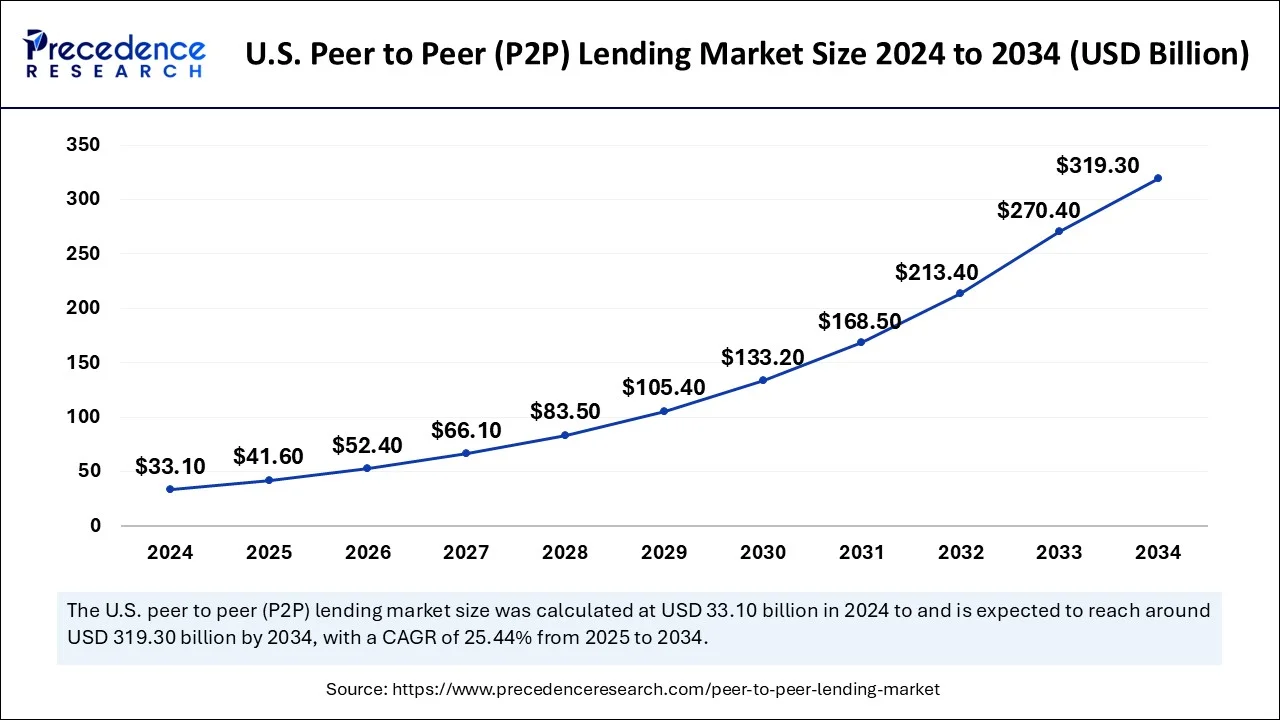
The U.S. peer to peer (P2P) lending market size is exhibited at USD 41.60 billion in 2025 and is projected to be worth around USD 373.6 billion by 2035, growing at a CAGR of 24.55% from 2026 to 2035.
North America led the peer to peer (P2P) lending market in 2025 by holding 37.40% of the market share. North America generally has a more conducive regulatory environment for P2P lending compared to other regions. Regulatory clarity and frameworks that facilitate lending activities have allowed platforms to operate more smoothly and attract both borrowers and investors.
North America generally has a more conducive regulatory environment for P2P lending compared to other regions. Regulatory clarity and frameworks that facilitate lending activities have allowed platforms to operate more smoothly and attract both borrowers and investors. North America has a well-established credit infrastructure, including credit bureaus and scoring systems, which facilitates the assessment of borrower creditworthiness. This infrastructure reduces the risk for lenders participating in P2P lending platforms and encourages investor participation.
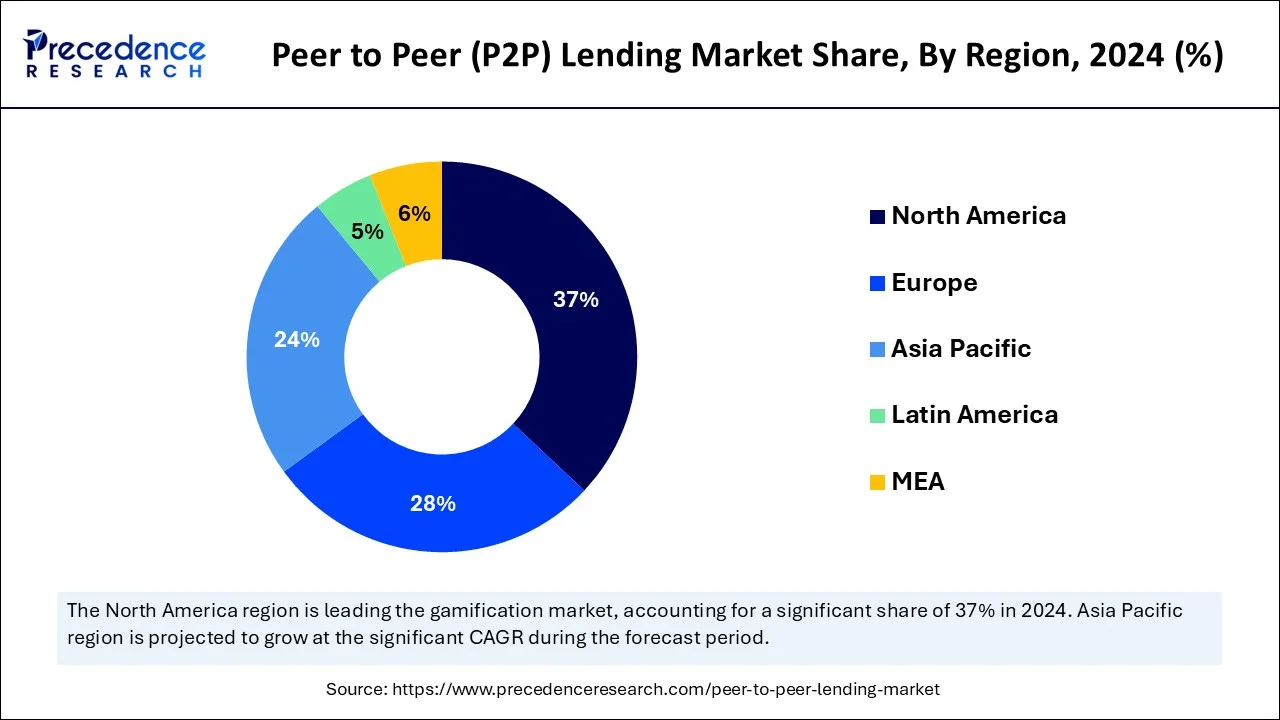
Asia-Pacific is expected to develop at the fastest rate during the forecast period. China dominates the peer to peer (P2P) lending market in Asia-Pacific region. The peer to peer (P2P) lending market is growing in Asia-Pacific region due to growing number of small and medium sized enterprises. The government of emerging nations such as China and India are constantly taking efforts for the promotion of cashless technologies. This factor is boosting the growth of peer to peer (P2P) lending market in the region.
Europe
In Europe, the P2P lending ecosystem is maturing, particularly in countries such as the United Kingdom, Germany, and the Nordic nations, which are emerging as regional leaders. Harmonized, Germany, and the Nordic nations, which are emerging as regional leaders. Harmonized regulatory frameworks within the European Union have encouraged cross-border expansion of platforms like Funding Circle, Zopa, and Bondora, facilitating increased transparency and scalability. Notably, the UK remains at the forefront in terms of both business lending volume and platforms innovation, edging out other markets in overall activity. While dominant markets help anchor the region, smaller European countries such as Estonia, with these dominant markets help anchor the region, smaller European countries such as Estonia, with platforms like Bondora are building their fintech momentum, though remain in relative comparison modest in scale.
Latin America
Latin America's P2P lending market is still nascent but expanding rapidly, propelled by surging fintech creation, alternative credit demand, and rising internet mobile penetration. Mexico and Brazil currently lead the region in P2P activity, with Argentina and Chile also gaining traction. Platforms like Afluenta have pioneered regional expansion, offering personal and commercial lending across countries. Yet the regional growth depends heavily on evolving regulatory environments. Nations such as Mexico and Brazil have enacted specific fintech regulations, while other like Uruguay and Argentina continue to refine or lack comprehensive frameworks creating both growth opportunities and regulatory uncertainty. Furthermore, the rappid proliferation of fintech start-ups particularly those catering to undeserved population points to fertile yet challenging market for P2P lenders.
Competitive Landscape
The peer to peer (P2P) lending market is witnessing massive recognition due to the smart bank alliances that promote the trends of the market. The utilization of modest technologies such as AI and digitals are gaining traction in the online lending businesses. The bolstering of SME operations and the potential of funding platforms are upscaling the P2P lending concept with trust and stability. The market leaders such as Funding Circle, Mintos, Upstart, LendingClub, and Faircent are the spine of the market businesses.
Company Profiles
Funding Circle
- HQ: London, United Kingdom.
- Founded: 2010
- Ownership: Financial Technology Company.
- Business Overview: Funding Circle's business runs on its comprehensive and impressive offerings that allow individuals to secure term loans. The business is popular for its P2P lending platform. The engagement with institutional investors bolsters the company's position in the market.
- Products: Business credit card, loans and other facilities and schemes.
- Geographic Presence: Company operate across 50 U.S. states.
- Revenue: The company's 2025 revenue was £204.3 million and is expected to grow during the forecast period.
- Recent Development: In October 2025, Funding Circle and TNT Sports confirmed their financial business deal. Following this, Funding Circle will get in-show brand integration advantages throughout the live coverage of different events. This alliance indicates the company's expansion strategy that will further help fuel market hype in future deals.
- Key Strategies: Funding's strategy is to add more institutional funding pillars and expand the multi-product offerings. The business with SMEs is the biggest strength to the company's dynamics.
Mintos
- HQ: Riga, Latvia.
- Founded: 2014
- Ownership: Multi-asset investment platform.
- Business Overview: Mintos stands on its strong-headed investment advice and offerings business, whereas its funding model shapes the business quality at every stage, helping individuals to secure long-term money.
- Products: Loans, bonds, ETF portfolios, etc.
- Geographic Presence: The company has international offices, with its popular location in Berlin, Germany. It owns a pan-European investment platform tag with 500,000 users.
- Revenue: The company's revenue in 2025 was €10.39 million (turnover) and is expected to grow in the coming years.
- Recent Development: In February 2026, Mintos' co-founder Martins Sulte, in his post, pointed out its strategy of turning its existing investment platform into a bank. The company is awaiting a banking license to begin its lending and other operations.
- Key Strategies: The company's strategy is to expand its footprint with the main business startups that will give a center stage to the company in this market and other relevant industries.
Upstart
- HQ: San Mateo, California.
- Founded: 2012
- Ownership: Cloud-related AI lending platform.
- Business Overview: Upstart's business is basically to promote the AI models and their potential participation in credit applications. The automation and efficiency in this application accelerate and attract financial institutions at the first stage of business.
- Products: HELOC, relief loans, personal loans, etc
- Geographic Presence: The company operates across U.S. credit markets.
- Revenue: The company's revenue for 2026 Q1 is $308 million and might increase to $365 million.
- Recent Development: In August 2026, the Upstart co-founder and CEO will be attending the Goldman Sachs Communacopia and Technology Conference 2026's Fireside Chat. This will bring valuable insights into consideration and allow the market to have a wider view in finances industries.
- Key Strategies: The company's strategy is to level up expertise and enhance its operations for users and the company's business betterment.
LendingClub
- HQ: San Francisco, California.
- Founded: 2006
- Ownership: Digital Marketplace Bank.
- Business Overview: The company's initial business began with introducing the first-ever P2P lending platform to users that later progressed into institutional investors. Digital banking is the milestone transition for the company.
- Products: Personal loans, banking services and account openings, etc.
- Geographic Presence: The company's new branding name ‘Happen Bank' continues to operate within the United States.
- Revenue: The 2025 annual revenue was $0.99 billion USD and is expected to increase in the coming years.
- Key Strategies: The company's smart holding and dual funding strategy is a moonwalk for a long-standing business. The current acquisition move is an added value to the company's expansion business.
Faircent
- HQ: Gurugram, India.
- Founded: 2013
- Ownership: P2P lending platform.
- Business Overview: Faircent's main business is to continue with its virtual marketplace that will help individuals interact with institutional lenders. This seamlessly resolves the emerging hurdles often faced by connecting to the traditional bank process for any kind of loan.
- Products: P2P retail loans, faircent Pro, Open API platform.
- Geographic Presence: The company operates in the domestic Indian market.
- Revenue: In 2025, the company's revenue was ₹27.4 crore and is expected to increase in the coming years.
- Key Strategies: The company's strategy is to enhance the lending model to meet the required compliances as the tension for the same is active. The expansion, therefore, will be seamless and safe for users to trust.
Peer to Peer (P2P) Lending Market Companies
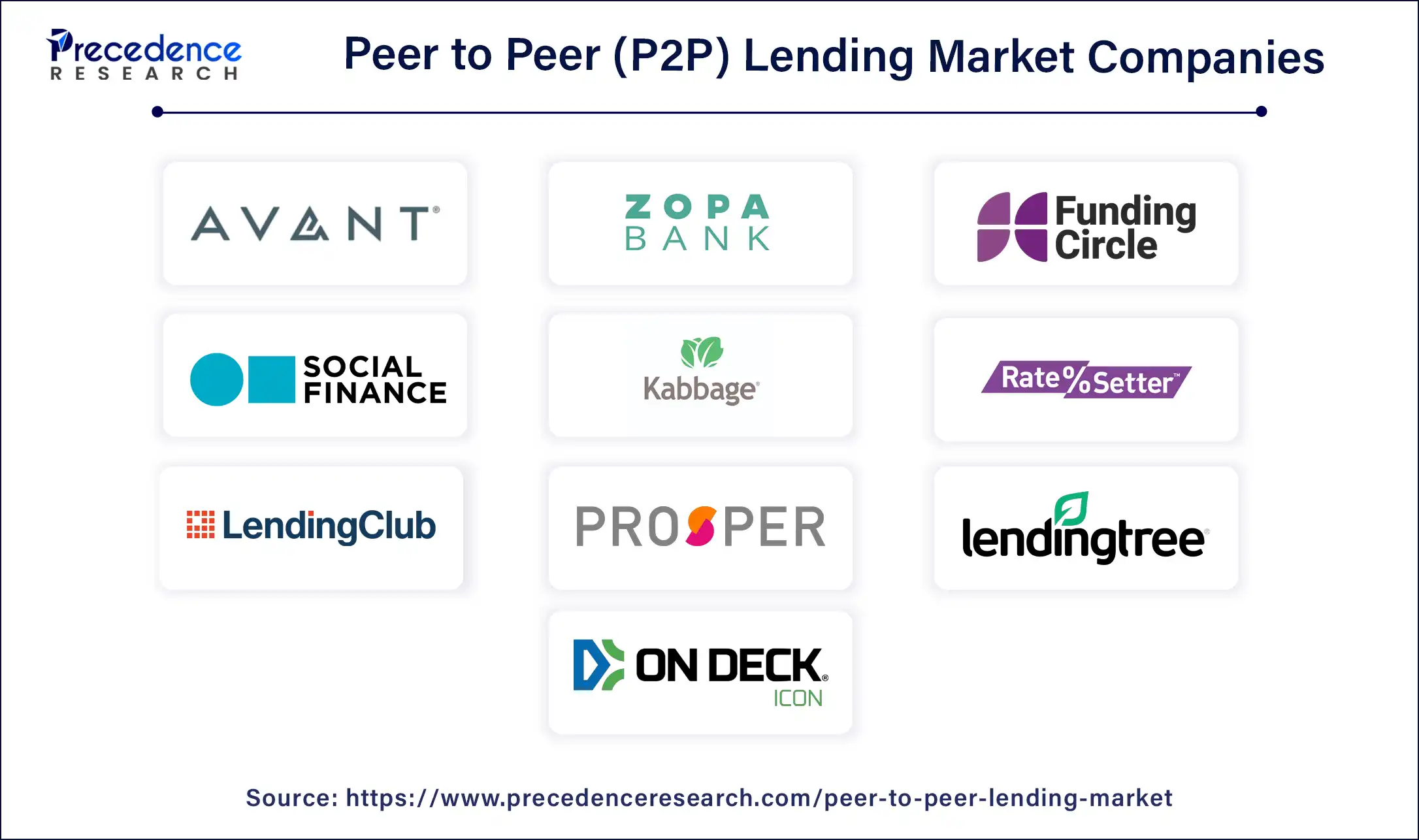
- Avant LLC
- Zopa Bank Limited
- Funding Circle
- Social Finance Inc.
- Kabbage Inc.
- RateSetter
- Lending Club Corporation
- Prosper Funding LLC
- LendingTree LLC
- OnDeck
Recent Developments
- July17, 2025, Funding Circle, once a retail peer to peer lending pioneer, has staged a notable comeback. The UK- based platform extended substantially more credit in the first half of 2025 compared to the prior year, translating into a return to profitability after restructuring and existing the U.S. market. Under new leadership, the company reversed a sizable loss into a modest profit and is on track to boost its pre-tax profits and revenues by 2026. This turnaround underscores renewed investor confidence and the firm's shift toward institutional funding models.
- June 12, 2025, The Carlyle Group has joined with Citigroup to roll asset backed financing specially targeted at fintech lenders. This initiative aims to meet escalating demand for scalable funding solutions within the P2P and fintech lending sectors. By combining Carlyle's infrastructure financing expertise and Citi's extensive private credit capabilities, the partnership signals strong institutional confidence in fintech's growth and opens new funding pathways for emerging lending platforms
- In January 2025, LenDenClub, a prominent P2P lending platform announced the launch of a new daily earning loan that allows lenders to earn daily interest with principal repayments. With this offering, lenders and investors can get a choice of loans starting from nine months tenure.
- In October 2024, IndiaP2P launched a new version of its services, the Monthly Income Plan-Plus. This offering adheres to the RBIs updated and faster settlement guidelines for P2P lending. Under this offering, lenders can earn up to 18% per annum interest with monthly payouts.
- In December 2024, Defender Global announced the launch of P2P lending platform while securing $235,000 for real-world projects. The company has settled the aim to position itself to meet the rising demand for asset-backed and accessible investment.
Segments Covered in the Report
By Type of Lending
- Consumer Lending
- Business Lending
By End User
- Consumer Credit Loans
- Small Business Loans
- Student Loans
- Real Estate Loans
By Business Model
- Traditional Lending
- Marketplace Lending
By Region
- North America
- Europe
- Asia-Pacific
- Latin America
- Middle East & Africa
For inquiries regarding discounts, bulk purchases, or customization requests, please contact us at sales@precedenceresearch.com
Frequently Asked Questions





Ask For Sample
No cookie-cutter, only authentic analysis – take the 1st step to become a Precedence Research client
 Get a Sample




 sales@precedenceresearch.com
 Schedule a Meeting
